Seedance 2.0 storyboard animation with environment reference
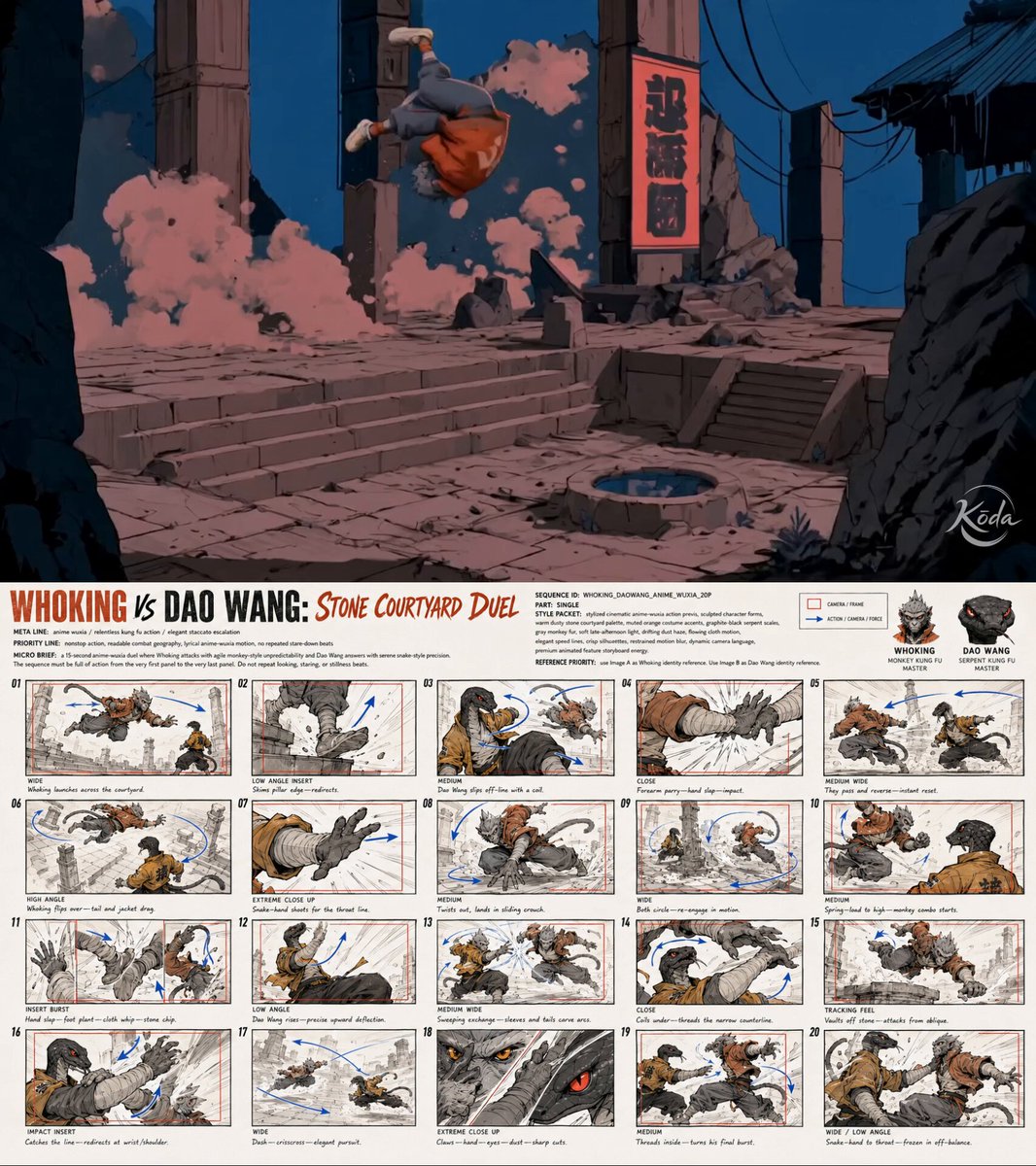
GPT Image 2 + Seedance 2.0 Prompt Share Created on @mitte_ai I used the generic Seedance 2.0 storyboard-to-video prompt again, without any additional details. To get this style, I added an environment reference created in Midjourney. Without that reference image, it generates a stylized 3D version. You can check the prompts in the comments.
- Reply 1 from @aimikoda
GPT Image 2 Prompt for Storyboard: Create a 16:9 STORYBOARD SHEET image. Use the two provided reference images for character identity only. Image A is Whoking, the monkey kung fu master. Image B is Dao Wang, the serpent kung fu master. [PROJECT CARD] Create a designed typographic masthead at the top of the sheet, not a table. TITLE LOCKUP: WHOKING VS DAO WANG: STONE COURTYARD DUEL META LINE: anime wuxia / relentless kung fu action / elegant staccato escalation PRIORITY LINE: nonstop action, readable combat geography, lyrical anime-wuxia motion, no repeated stare-down beats MICRO BRIEF: a 15-second anime-wuxia duel where Whoking attacks with agile monkey-style unpredictability and Dao Wang answers with serene snake-style precision. The sequence must be full of action from the very first panel to the very last panel. Do not repeat looking, staring, waiting, posing, or stillness beats. Start with action immediately and end on a strong action finish. [CONTINUITY HEADER] SEQUENCE ID: WHOKING_DAOWANG_ANIME_WUXIA_20P PART: SINGLE STYLE PACKET: stylized cinematic anime-wuxia action previs, sculpted character forms, warm dusty stone courtyard palette, muted orange costume accents, graphite-black serpent scales, gray monkey fur, soft late-afternoon light, drifting dust haze, flowing cloth motion, elegant speed lines, crisp silhouettes, restrained motion blur, dynamic camera language, premium animated feature storyboard energy. REFERENCE PRIORITY: use Image A as Whoking identity reference and Image B as Dao Wang identity reference. [SUBJECTS] WHOKING: monkey kung fu master, gray fur, amber eyes, red-orange short jacket, wrapped torso, loose gray pants, tail, agile and unpredictable. His fighting language is spring-loaded monkey style: low crouches, sudden leaps, hand slaps, aerial changes of direction, playful feints, quick scrambling footwork, low-to-high attacks. DAO WANG: serpent kung fu master, black scaled serpent head with glowing red eyes, mustard-orange martial jacket, wrapped forearms and feet, dark loose pants, upright disciplined posture. His fighting language is snake style: precise tracking, coiling evasions, narrow-line counters, throat-line strikes, exact hand shapes, minimal wasted motion, eerie calm. [SCENE] Set the duel in an open stone courtyard with worn paving, low steps, broken pillars, drifting dust, and open negative space for readable action. The environment should be simple and elegant. Show clear orientation, direction, counters, pressure changes, gliding landings, cloth arcs, tail curves, dust trails, and small stone-chip accents. [STORYBOARD FORMAT] Use a 5 x 4 grid for 20 panels. This is a fast anime-wuxia action sheet. Every panel should contain action or immediate action continuation. No repeated face-off panels. No repeated stillness panels. No dead air. Panel numbers should be outside the frames. Add short shot labels and tiny micro-action captions under each panel. Use red frame boxes to indicate camera framing. Use blue arrows to indicate motion, attack direction, camera movement, body travel, and force lines. Keep the sheet clean, premium, cinematic, and easy to scan. [VISUAL LANGUAGE] Rough hand-drawn storyboard look. Loose black linework. Gray tonal shading. Red framing boxes. Blue motion arrows. Minimal but clear environment drawing. Characters simplified but expressive and instantly distinguishable by silhouette. Do not render as a finished illustration. This must look like a professional anime action previs storyboard sheet. [ANIME WUXIA ACTION DNA] The choreography should feel anime-wuxia: flowing, elegant, sharp, airborne, lyrical, and heightened, but still readable. Emphasize fast rhythmic cutting, dynamic perspective, strong silhouettes, cloth and tail flow, speed-line energy, and elegant cause-effect combat beats. The action should feel mythic and fluid, not comedic. Every movement should have a clear before-and-after logic. [SHOT DESIGN RULES] Use strong shot variety: wide, medium-wide, medium, close-up, extreme close-up, low angle, high angle, over-shoulder, tracking-feel shots, impact inserts, reaction inserts. Maintain readable combat geography. Include occasional wide resets, but they must still contain active movement, not static posing. Do not clutter panels. Prioritize one clear action idea per panel. [20 PANEL ACTION BEAT MAP] 01. Action opening wide shot, Whoking is already airborne lunging across the stone courtyard toward Dao Wang. 02. Low-angle insert, Whoking’s foot skims a pillar edge or stone step to redirect momentum. 03. Medium action beat, Dao Wang slips off-line with a coiling snake-body motion as Whoking slashes past. 04. Close impact insert, forearm parry and hand-slap contact with dust and sleeve arc. 05. Medium-wide crossing beat, both fighters pass each other and instantly reverse direction. 06. High-angle action beat, Whoking flips over Dao Wang with tail and jacket trailing. 07. Extreme close-up insert, Dao Wang’s snake-hand shoots toward Whoking’s throat line. 08. Medium evasive beat, Whoking twists midair and lands in a sliding crouch while redirecting with one hand. 09. Wide active reset, both circle in motion around broken pillars, kicking up dust while re-engaging. 10. Medium escalation beat, Whoking springs from low to high in a rapid monkey-style combo. 11. Insert burst, hand slap, foot plant, cloth whip, stone chip, speed-line motion. 12. Low-angle counter beat, Dao Wang rises through the pressure with a precise upward serpent deflection. 13. Medium-wide clash, both collide in a sweeping exchange with flowing sleeves and clean silhouettes. 14. Close-up insert, Dao Wang coils under an overhead strike and threads a narrow counterline. 15. Dynamic tracking-feel shot, Whoking vaults off a low stone surface and attacks from an oblique angle. 16. Impact insert, Dao Wang catches or redirects the line at the wrist and shoulder with exact economy. 17. Wide escalation shot, both dash across the courtyard in a fast elegant crisscross exchange. 18. Extreme close-up insert, claws, wrapped hand, eyes, dust, and cloth all cutting past in sharp anime rhythm. 19. Medium finishing clash, Dao Wang threads inside Whoking’s final burst and turns the momentum. 20. Strong ending action frame, Dao Wang’s finishing snake-hand stops at Whoking’s throat while Whoking is still in motion and off-balance, with both bodies forming a dramatic frozen-action silhouette. [IMPORTANT COMBAT RULES] The action must read clearly. Each panel must show cause and effect. The sequence must feel nonstop, fast, graceful, and premium. Whoking must feel agile, spring-like, mischievous, and fluid. Dao Wang must feel serene, exact, economical, and intimidating. Keep start and end action-heavy. Avoid repetitive anticipation, repeated stare-downs, empty pause panels, and static hero poses. [NEGATIVE] no polished final illustration no soft vague posing no unreadable action clutter no repeated staring panels no repeated stillness panels no comedy tone no logos no watermark


- Reply 2 from @aimikoda
Seedance 2.0 Storyboard-to-Video Prompt: Use @[storyboard ref] as the authoritative 15-second cinematic shot blueprint. Do not render the storyboard sheet itself: exclude all panel borders, headers, text, labels, project card, director strip, style swatches and page layout from the final video. Treat each panel as an individual sequential shot guide, not as one combined image or split-screen. Follow panel order exactly, preserving staging, camera angle, framing, character placement, action beats, motion direction, timing rhythm and shot-to-shot continuity. Use the panel drawings for choreography, geography and composition only; translate the rough sketches into the intended final video style. Interpolate natural motion between panels, preserving start/end poses, prop states, effect states and screen direction. Allocate the 15 seconds across panels according to visual emphasis and rhythm. Do not invent new major actions, locations, characters, props, effects or alternate camera setups. Connect the panels into one smooth continuous action sequence with readable silhouettes, controlled motion blur and clear cinematic momentum.

- Reply 3 from @aimikoda
@Aliaksei_AI @mitte_ai Thanks! I added the character sheets and environment reference, but didn't tag them in the prompt.
- Reply 4 from @aimikoda
@MayorKingAI @mitte_ai Thanks, mate! Glad you liked it! 🙌
- Reply 5 from @aimikoda
@TechieBySA @mitte_ai Who knows? 😅
- Reply 6 from @aimikoda
@Ankit_patel211 @mitte_ai Thank you, Ankit!
- Reply 7 from @aimikoda
@Aliaksei_AI @mitte_ai I'm not saying tagging is unnecessary, I tag them most of the time too. But in this one, the storyboard already has the reference info and most of the time the model understands the references.
Upload your character and run this pipeline.
The prompts above are pre-filled in the workbench. Swap in your image and tweak the topic — first generation is free.
Try this technique →